
Fence Staining in Nesconset, NY
Wooded Lots Here Work Against Your Fence

Hear from Our Customers

Wood Fence Protection in Nesconset
Most homeowners in Nesconset don’t think about their fence until something is visibly wrong a board is splitting, the wood has gone gray, or the base is soft. By that point, staining isn’t just maintenance anymore. It’s damage control. The good news is that a professional staining job done at the right time can add years to your fence’s life and keep you out of a full replacement conversation that runs $3,000 to $8,000 or more.
Nesconset’s wooded lots create a specific problem that open suburban neighborhoods don’t face the same way. Fences along tree lines stay damp longer after rain, collect leaf debris at the base, and sit in shade conditions that promote mold and mildew growth inside the wood grain. That’s not a cosmetic issue it’s structural. A penetrating stain applied by someone who understands these conditions seals the wood against moisture infiltration before the damage can compound.
The freeze-thaw cycle that hits inland Suffolk County every winter makes this even more urgent. Unlike the South Shore towns closer to the water, Nesconset gets hard freezes followed by rapid thaws sometimes multiple times in a single week during late winter. When untreated wood absorbs moisture and then freezes, it expands and cracks from the inside out. You won’t see that damage on the surface right away, but it’s happening. Staining is what stops it.
Fence Staining Company Nesconset, NY
We’ve been doing this work across Suffolk County for over 15 years, and we know Nesconset’s specific conditions inside and out. That means we’ve stained fences on wooded half-acre lots through enough Long Island winters to know exactly what holds and what doesn’t. We know what the Town of Smithtown requires for permitted fence work. We know how shade and organic debris from mature oaks and pines accelerate wood decay along fence lines in this area. That local experience shows up in how we assess your fence before we ever apply a product.
Every estimate we provide is itemized lineal footage, labor, product, prep work all of it broken out so you can see exactly what you’re paying for. No round numbers, no vague ballpark figures that expand once the job starts. If you’ve hired a contractor before who handed you a one-line estimate and then surprised you at the end, you already know why this matters. We operate differently, and it’s reflected in every quote we give.
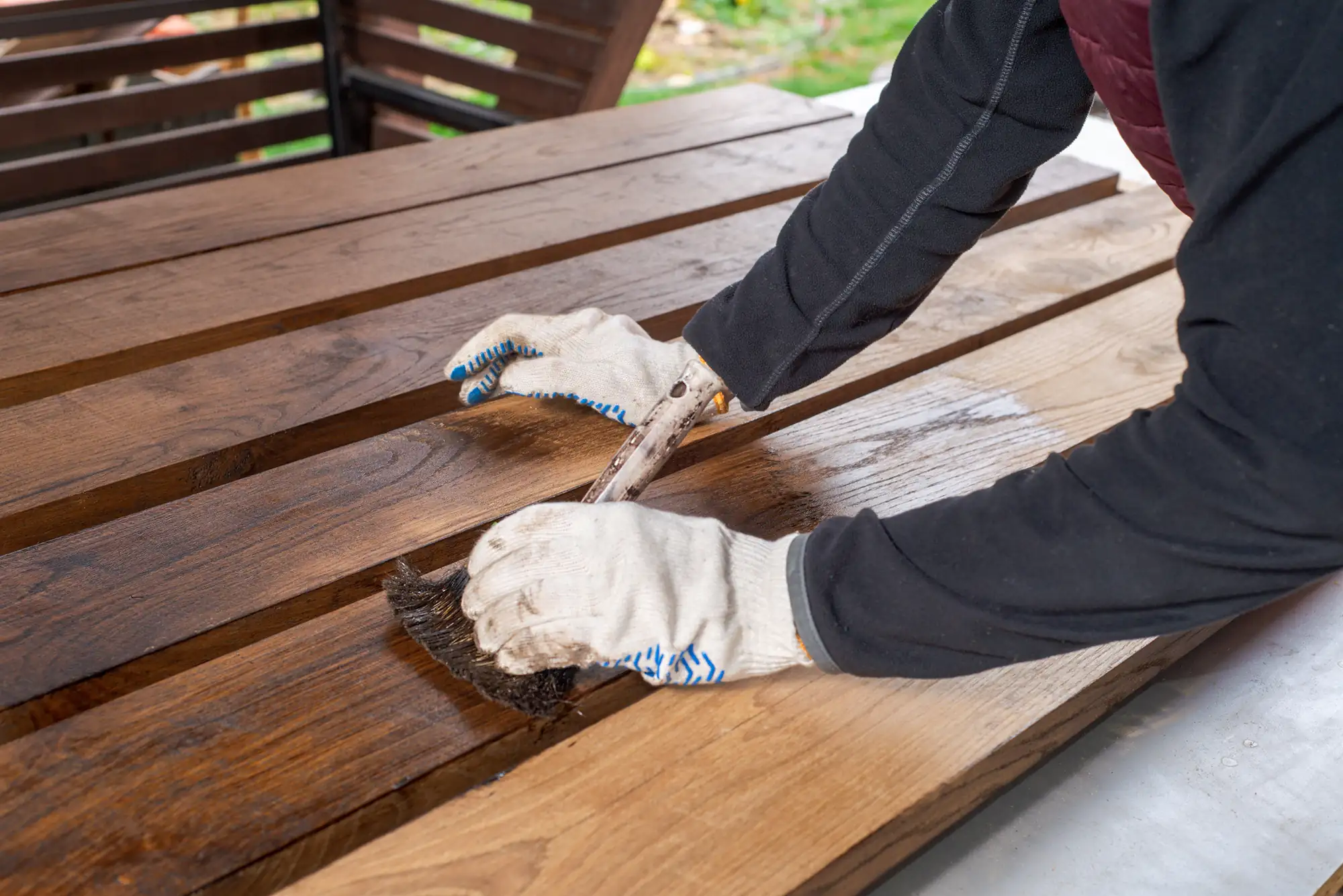
Professional Fence Staining Process Nesconset
It starts with a site visit. Before we quote anything, we come out to your property in person. We look at the fence’s current condition, assess what type of wood you’re working with, check for any existing damage, and verify property lines. In Nesconset, where a lot of the housing stock dates back to the 1970s and fences have sometimes been repositioned or replaced without updated surveys, that verification step matters more than most homeowners realize. We also locate utilities before any work begins not something every contractor does, but something that protects you.
From there, we give you an itemized quote. You’ll see the lineal footage, the product we’re recommending and why, the prep work involved, and the labor cost all separated out. Once you approve it, we schedule the job for the right window. In Nesconset, the optimal staining seasons are late spring after the last freeze and before summer humidity peaks and early fall before the first freeze arrives. Staining outside those windows, especially during the heat and humidity of a Long Island July or August, risks the product drying on the surface before it penetrates the wood grain. We time our work accordingly.
On the day of the job, we start with a thorough clean. Organic debris, mold, mildew, and surface weathering all have to come off before any stain goes on skipping this step is the number one reason DIY staining jobs fail within a season. After the surface is prepped and dry, we apply the stain in the right conditions and let it cure properly. When we leave, your fence is protected, and you have written warranty coverage on both the workmanship and the materials.

Ready to get started?
Fence Staining and Sealing Nesconset, NY
Fence staining isn’t just brushing color onto wood. What you’re actually paying for is the prep, the assessment, the right product selection for your specific conditions, and the application done correctly so the protection actually lasts. On a Nesconset property where shade from mature trees, seasonal moisture, and organic debris are constant factors the prep work is often the most important part of the job. We clean the fence surface, remove biological growth, and make sure the wood is ready to accept the stain before a single coat goes on.
We also handle storm and vehicle damage repair as part of our scope. If a summer thunderstorm dropped a branch on your fence and Nesconset’s wooded lots make that a realistic scenario every season we can assess the damage, repair what needs to be repaired, and apply protective staining in the same engagement. You don’t need to coordinate two separate contractors or wait on one before calling the other.
All materials we use are American-made, and we carry warranties on both workmanship and materials. If the application fails due to something on our end, we fix it. If the product itself fails within the warranty period, that’s covered too. For homeowners in a community where median home values are approaching $770,000, that dual coverage isn’t a bonus it’s the standard you should expect from any contractor working on your property. We also follow environmentally responsible practices throughout, including responsible disposal of waste materials, so nothing we do on your lot harms the trees and plantings that make your property what it is.

How often should I stain my wood fence in Nesconset, NY?
For most wood fences in Nesconset, every two to three years is the right interval but the honest answer is that it depends on your specific conditions. A fence that runs along a tree line on a shaded, wooded lot will show wear faster than one that faces open sky, because shade and moisture retention accelerate mold growth and wood breakdown in ways that UV exposure alone doesn’t.
The easiest way to check if your fence needs staining is the water bead test. Splash some water on the wood surface. If it beads up and rolls off, the existing stain is still doing its job. If the water absorbs into the wood within a few seconds, the protection has worn down and it’s time to restain. Don’t wait until the wood is visibly gray or soft by that point, you’re restoring rather than maintaining, and restoration takes more work and costs more. Staying ahead of it on a two-to-three-year cycle is almost always the cheaper path.
What’s the best time of year to stain a fence on Long Island?
Late spring and early fall are the two best windows for fence staining in Nesconset and across inland Suffolk County. You’re looking for temperatures between roughly 50°F and 80°F with moderate humidity conditions where the stain can penetrate the wood grain and cure properly rather than drying too fast on the surface.
Summer in this area can work against you. July and August bring heat and humidity levels that cause stain to skin over on the surface before it’s had a chance to soak in, which means the protection you’re paying for never fully develops. Winter staining is off the table entirely stain applied in freezing temperatures won’t cure, and you’ll end up with a finish that peels or fails within a season. If you’re planning a project, aim for May or September. Those months consistently give you the conditions where the work actually holds.
My fence is turning gray and weathered can it be restored, or does it need to be replaced?
Graying and surface weathering don’t automatically mean your fence is done. That gray color is UV oxidation the wood’s surface cells breaking down from sun exposure and in many cases it’s a surface condition, not a structural one. If the wood is still solid when you press on it, hasn’t started to splinter or crack deeply, and the posts are still set firmly, restoration staining is very likely a viable option.
The process involves cleaning the surface thoroughly, sometimes using a wood brightener or light sanding to open up the grain, and then applying a penetrating stain that soaks into the wood rather than sitting on top of it. Done correctly, a restored fence can look significantly better and hold up for years with regular maintenance from that point forward. The case for restoration is especially strong in Nesconset, where replacement fencing on a half-acre wooded lot can run well into the thousands. A restoration job at a fraction of that cost, followed by a regular staining schedule, is usually the smarter financial decision.
Does fence staining require a permit from the Town of Smithtown?
No fence staining is a maintenance activity, not a structural change, so it doesn’t require a permit from the Town of Smithtown Building Department. You can have your fence stained without any permit application or approval process.
Where permits do come into play is if you’re replacing fence sections, adding height, or installing a new fence. The Town of Smithtown requires a permit for any fence over four feet in height. That application requires a notarized submission from the property owner, copies of your property survey showing the fence location, and proof of contractor licensing and insurance. If you’re combining a staining job with any structural repair or replacement work, it’s worth knowing where that four-foot threshold sits before the work starts. We walk through all of this during our site visit so there are no surprises mid-project.
How much does professional fence staining cost in Nesconset?
Professional fence staining typically runs between $1,400 and $2,200 for most residential properties, with per-linear-foot pricing generally falling in the $2 to $10 range depending on fence type, condition, and how much prep work is involved. A fence that’s in good shape and just needs a maintenance coat will come in toward the lower end. A fence with significant surface weathering, mold buildup, or previous stain that needs to be stripped will require more prep and cost more accordingly.
For Nesconset homeowners with larger wooded lots half-acre to full-acre properties are common here the linear footage tends to be higher than a more compact suburban lot, which affects total cost. The right way to get an accurate number is through an in-person assessment, not a phone estimate. We provide fully itemized quotes after seeing the fence in person, so you know exactly what each line item covers before you commit to anything. Compare that to a replacement cost of $3,000 to $8,000 or more, and the math on regular staining is pretty straightforward.
My fence was damaged in a storm should I repair it before staining, or can it be done at the same time?
Both can absolutely be handled in the same visit, and for most homeowners in Nesconset that’s the more practical approach. Trying to stain a fence with damaged boards or compromised posts doesn’t make sense the stain won’t protect wood that’s already structurally compromised, and you’d just be covering up a problem that will get worse. The right sequence is repair first, then stain, and we handle both.
Nesconset’s wooded lots make storm damage a realistic scenario every summer. When a mature oak or pine drops a branch on a fence panel during a July thunderstorm, the damage is often a mix of broken boards, shifted posts, and surface splintering all of which need to be addressed before any protective coating goes on. We assess the full scope of damage during our site visit, give you a clear breakdown of what the repair involves and what the staining will cover, and handle it as a single job. If you’re working with a homeowner’s insurance claim, we can help document the damage in a way that supports that process.
Useful Links
Other Services we provide in Nesconset