Wood vs Vinyl Fence: The Honest Comparison for Long Island
Trying to choose between wood and vinyl for your Long Island fence? Here’s the honest comparison most contractors won’t give you.

If you’re trying to decide between wood and vinyl, you’ve probably already read a few comparisons that felt like they were written by someone trying to sell you vinyl. Or someone trying to sell you wood. This isn’t that.
The truth is, both materials have real advantages — and the right answer depends on a few things specific to your property, your plans, and where you live. For Suffolk County homeowners in particular, the local climate plays a bigger role in this decision than most people realize. We’re going to walk through all of it — costs, lifespan, maintenance, style options, and what we’ve seen hold up best on Long Island after more than 15 years in the business.
Wood Fence vs Vinyl Fence: The Real Cost Comparison Over Time
Here’s where most people get tripped up. Wood looks like the budget option when you’re comparing day-one prices, and in terms of upfront installation cost, it often is. In Nassau and Suffolk County, wood cedar board-on-board typically runs around $22–$38 per linear foot installed, while vinyl comes in at roughly $28–$55 per linear foot installed. So yes, wood can cost less to put up.
But that’s only part of the picture. A wood fence needs to be stained or sealed every few years, repaired as boards warp or rot, and eventually replaced entirely. Vinyl needs almost none of that — an occasional rinse is about all it asks for. When you factor in maintenance and the likelihood of at least one full replacement, a wood fence over 25 years can cost dramatically more than vinyl over that same period. The upfront savings disappear fast.
Semi Privacy Fence: What It Is and Which Material Makes More Sense
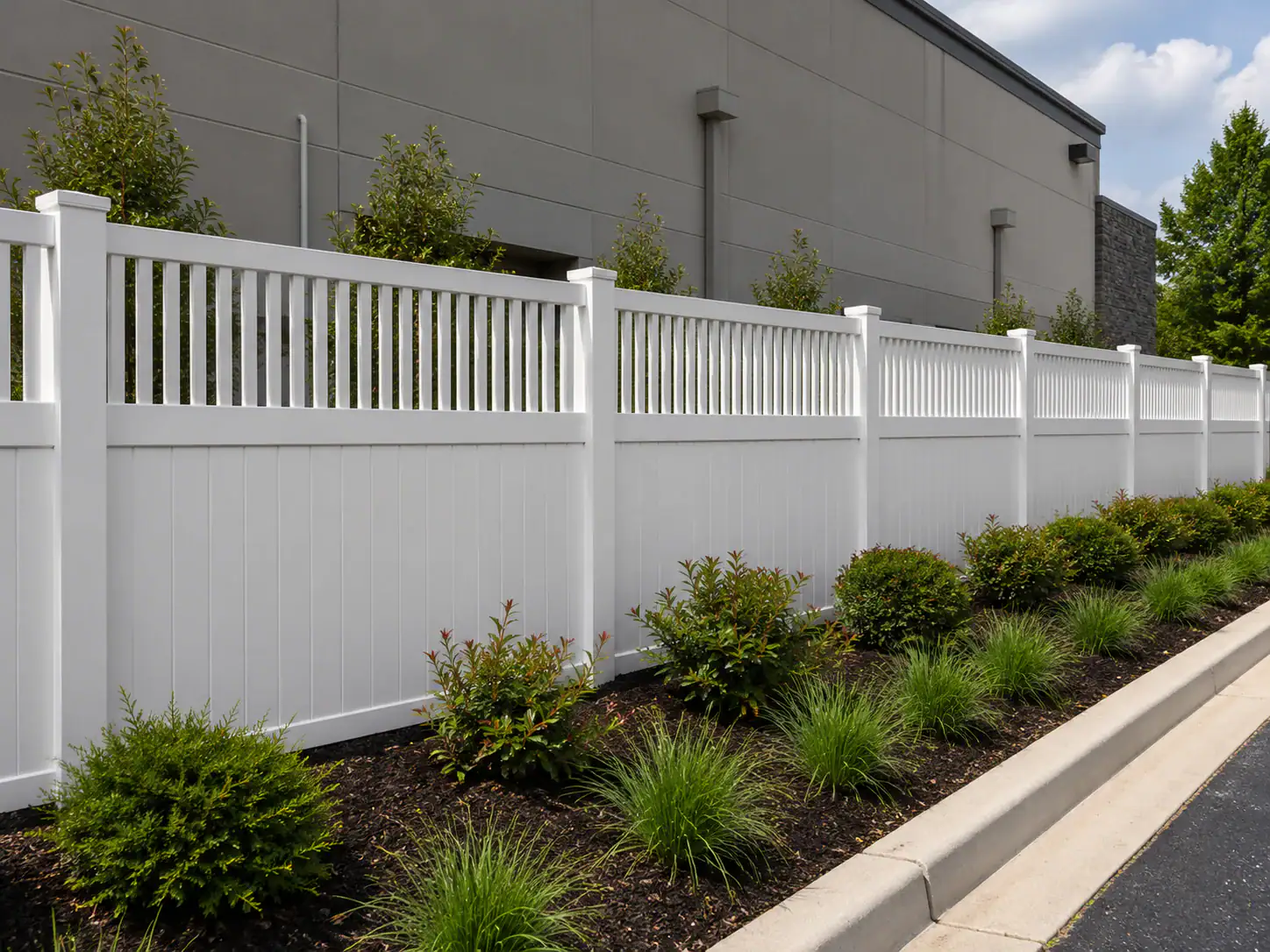
A semi-privacy fence is exactly what it sounds like — it gives you most of the privacy of a solid fence without completely closing off your yard. Boards or pickets are spaced slightly apart, which lets air move through, softens the look, and keeps the yard from feeling like a bunker. It’s one of the most popular styles we install across Suffolk County, particularly in neighborhoods where a full privacy wall would feel out of place or where HOA rules limit solid fencing.
Both wood and vinyl work well for semi-privacy designs. The style itself — the spacing, the height, the profile of each board — can be replicated in either material. The difference comes down to what happens after installation.
A wood semi-privacy fence will need restaining every three to five years, and the boards that take the most sun or moisture exposure tend to warp or grey faster than the rest. You’ll likely find yourself replacing individual boards before the whole fence needs to go. In Suffolk County’s humid summers and freeze-thaw winters, this cycle can start sooner than homeowners expect.
A vinyl semi-privacy fence holds its color, holds its shape, and doesn’t ask much of you. On Long Island, where summers are humid and winters bring real freeze-thaw stress, that matters more than it might in a drier climate. The wood grain texture options available in modern vinyl have also closed the gap on aesthetics — many homeowners genuinely can’t tell the difference from the street.
If you’re staying in your home for five or more years and you don’t want to think about your fence again, vinyl is the stronger call for this style. If you’re selling in the next couple of years and you want to keep upfront costs down, wood is a reasonable short-term choice — just go in knowing what the maintenance cycle looks like.
Crossbuck Fence: A Style Worth Knowing Before You Decide on Material
The crossbuck fence doesn’t come up in most material comparisons, but it should — especially for properties along the north shore, larger lots in Smithtown or Riverhead, or any homeowner going for a farmhouse or estate aesthetic. The crossbuck design features an X-shaped diagonal brace between horizontal rails, which gives it a classic, open look that works beautifully as a front boundary, along a driveway, or bordering a larger property without blocking sightlines.
What most people don’t realize is that crossbuck fencing is available in vinyl, and it’s one of the styles where vinyl’s advantages are most obvious. Wood crossbuck fencing looks great when it’s new and freshly painted, but the open rail design means more surface area exposed to the elements — more edges to crack, more joints to separate, more spots where moisture gets in. On Long Island, where we get real winters and salt air from multiple directions, that exposure adds up.
Vinyl crossbuck panels hold their structure without the same vulnerability. The X-bracing in quality vinyl actually adds rigidity, and the material doesn’t absorb moisture the way wood does. You’re not refinishing it every few years. You’re not watching it grey out and pulling it apart at the joints. It just stays looking the way it looked on install day, with minimal attention from you.
We offer crossbuck in vinyl for exactly this reason — it gives homeowners the visual character of a traditional wood design without the upkeep that comes with it. If you’ve been drawn to this style but assumed it was only available in wood, it’s worth having a conversation about what vinyl can do here.
Want live answers?
Connect with a Best Fence Long Island expert for fast, friendly support.
Vinyl or Wood Fence: What Long Island’s Climate Actually Does to Your Choice
This is the part most national comparison guides skip over, and it’s the part that matters most for Suffolk County homeowners. Long Island is surrounded by water — the Sound to the north, the Atlantic to the south, the Great South Bay along the southern shore. That geography creates a persistently humid, salt-tinged environment that is genuinely hard on wood fencing.
Salt air accelerates rot. Humidity prevents wood from fully drying between rain events. Freeze-thaw cycles through December, January, and February cause wood to expand and contract, which cracks paint, opens joints, and warps boards over time. A wood fence that might last 15–20 years in a dry inland climate can show serious deterioration in 7–10 years in a yard close to the water in Patchogue, Islip, or anywhere along the south shore.

How Long Does a Wood Fence Last vs. Vinyl in Suffolk County?
The national average lifespan for a wood fence is 10–20 years with regular maintenance. Vinyl typically runs 20–30 years. But those are averages, and averages don’t account for Long Island’s specific conditions.
In our experience working across Suffolk County — from Centereach and Selden out to Riverhead, and south through Patchogue and Ronkonkoma — wood fences that aren’t kept up consistently tend to show real problems well before the 10-year mark. Much of Suffolk County sits on sandy, glacial outwash — the kind of well-draining, loose soil that’s great for drainage but gives fence posts less lateral support than clay-heavy ground does. Posts that aren’t set deep enough in concrete will start to lean, especially after a nor’easter or a wet winter.
That’s not a material issue, it’s an installation issue — but it’s one that affects wood and vinyl differently. A leaning post in a wood fence often means a warped or cracked panel. In a vinyl fence with properly set posts, the panel itself stays intact even if the post needs attention.
Superstorm Sandy is still a reference point for many homeowners across the county. Many of the wood fences that were replaced in 2012 and 2013 are now 10–12 years old and starting to show their age. If you’re looking at a fence that went up in that window, you’re likely looking at a fence that’s already approaching the end of its useful life — which makes now a reasonable time to think about what you want to replace it with, and whether the same material makes sense the second time around.
Do I Need a Permit for a Fence in Suffolk County, NY?
This question comes up constantly, and the honest answer is: it depends on which town you’re in. New York State generally doesn’t require a permit for residential fences under six feet on one- or two-family homes, but Suffolk County is divided into 10 separate towns — Brookhaven, Smithtown, Islip, Huntington, Babylon, Riverhead, and others — and each one has its own building department with its own specific rules. What’s fine in one town may require a permit in the next.
The Town of Brookhaven, which covers Centereach, Selden, Lake Grove, Port Jefferson, and Patchogue, is where a large portion of our work happens. If you’re in that jurisdiction, we know the process well. Same goes for Smithtown, Riverhead, and Ronkonkoma. We handle permit paperwork as part of the installation process, so you’re not left navigating multiple town offices on your own or guessing whether your project is compliant.
If you’re installing a fence around a pool, the rules are more specific — New York State requires a minimum 48-inch height with self-closing gates for any pool with water depth of 24 inches or more, and those requirements apply regardless of your town’s general fence rules. We make sure pool fencing meets code before we start, not after.
Not pulling a required permit isn’t just a technicality. If a permit was needed and you didn’t get one, you can face double fines and be required to re-apply from scratch. It’s one of the more avoidable headaches in a fence project, and it’s something we take off your plate entirely. If you want to verify our licensing independently, Suffolk County Consumer Affairs can confirm contractor status at 631-853-4600.
Which Fence Is the Better Choice for Your Long Island Property?
For most Suffolk County homeowners who plan to stay in their home for more than a few years, vinyl is the stronger long-term value. The upfront cost is higher, but the maintenance savings, the longer lifespan, and the way it holds up in Long Island’s coastal climate make the math work in its favor over time. That’s what the numbers show.
Wood is genuinely the right call in some situations. If you’re planning to sell in the next year or two and want to keep upfront costs low, or if you have a very specific aesthetic vision that only wood can deliver, it’s worth talking through. We install both, and we’re not going to push you toward one if the other makes more sense for your situation.
If you’re ready to get a clear picture of what your project would actually cost — with no vague estimates and no surprises at the end — Best Fence Long Island offers free on-site estimates with itemized written quotes. Reach out and we’ll take a look at your property, answer your questions, and give you a number you can count on.
Summary:
Table of Contents


Article details:
- Published by:
- Published to:
- Last modified:
- October 19, 2026
Share: