Finding Your Local Fence Company in Suffolk County
Not all fence quotes are created equal. Here’s what Suffolk County homeowners should know before hiring a local fence contractor.

You’ve decided it’s time for a fence. Maybe a storm took out the old one. Maybe you just moved in and the yard feels wide open. Maybe your kids or your dog need a clear boundary, and you’re done putting it off. Whatever the reason, you’ve started searching for a fence company near you — and now you’re looking at a list of names with no real way to tell them apart.
That’s where most homeowners get stuck. This guide is meant to get you unstuck. We’ll walk through what the process actually looks like in Suffolk County, what questions are worth asking, and what to watch out for before you commit to anyone.
What to Look for in a Fence Builder Near You in Suffolk County
The fence contractor market on Long Island is busy. There are established local companies, newer outfits, national franchise operators, and — especially after a bad storm — contractors who show up from out of the area, offer a low number, and disappear once the job gets complicated. Knowing how to tell the difference matters more than most homeowners realize.
The basics aren’t negotiable. Any fence builder near you worth hiring should be licensed and insured in Suffolk County. That’s not just a preference — New York State law requires home improvement contractors to be licensed, and you can verify any contractor’s status by calling the Suffolk County Department of Consumer Affairs at 631-853-4600. If a contractor can’t point you to their license, that’s your answer.
Beyond licensing, the next thing to look for is how we quote the job. A written, itemized quote is the standard for any professional contractor. If someone gives you a verbal number and moves on, you have no way of knowing what’s actually included — and that gap is where surprise charges live.
Do I Need a Permit to Install a Fence in Suffolk County?
This is the question most homeowners don’t think to ask until something goes wrong. The short answer is: it depends on your town, your fence height, and where on your property it’s going. The longer answer is that Suffolk County has ten separate towns — Brookhaven, Smithtown, Islip, Babylon, Huntington, Riverhead, Southampton, East Hampton, Southold, and Shelter Island — and each one runs its own building department with its own rules. In some cases, individual villages within those towns add another layer on top.
If you live in Centereach, Selden, Lake Grove, or Port Jefferson, you’re in the Town of Brookhaven. If you’re in Brentwood or Central Islip, you’re in the Town of Islip. Same county, different permit requirements. A fence that’s perfectly legal in one town might require a permit, a site plan, and a building department inspection in the next one over.
Most homeowners don’t know this going in, and a lot of contractors won’t bring it up unless you ask. That’s a problem, because installing a fence without the required permit can result in fines, forced removal, or complications when you go to sell the house. The permit process itself — submitting a site plan, waiting for approval, scheduling inspections — isn’t impossible, but it takes time and familiarity with the local system.
Working with a contractor who handles the permit paperwork for you isn’t just a convenience. In a county with this much town-by-town variation, it’s genuinely valuable. It removes the most friction-heavy part of the process and ensures the installation is done right the first time, by the book, without you having to become an expert in Brookhaven’s or Islip’s building department requirements.
We handle permit paperwork for all Suffolk County towns as a standard part of what we do. It’s one less thing on your plate, and it means the job gets done without loose ends.
Why Your Fence Quote Might Not Be Your Final Bill
Hidden fees are the most common complaint in the fence installation category, and they’re worth understanding before you start comparing quotes. The number a contractor gives you upfront often covers only the fence itself — the panels, the posts, and the labor to set them. What it frequently doesn’t include is the permit fee, gate hardware and installation, removal of your existing fence, any grading needed to level the ground, or the cost of having your utility lines marked before digging. Those extras can add ten to twenty percent to the total, and most homeowners don’t find out until the invoice arrives.
This is why itemized quotes matter. When a contractor breaks down exactly what’s included — materials, labor, gate work, removal, permit costs — you can actually compare one quote to another. Without that breakdown, you’re not comparing the same thing, and the lowest number on the page might not be the lowest final bill.
There’s another layer to this specific to Long Island. Central Suffolk County sits on sandy glacial soil, which has lower load-bearing capacity than the clay-heavy soil you’d find in other parts of the state. That means posts need to be set deeper and reinforced with more concrete to hold up over time — especially given the wind exposure that comes with living on Long Island. A contractor who skips that step to shave cost is setting you up for a fence that leans or falls after the first real nor’easter. It’s not a detail that shows up in the quote, but it’s one that shows up in the results.
Our quoted price is the final price. No add-ons at billing, no surprises when the job is done. We put it in writing, we go over it with you before we start, and we stand behind it.
Want live answers?
Connect with a Best Fence Long Island expert for fast, friendly support.
Hiring a Fencing Contractor in Suffolk County: What the Process Actually Looks Like
Once you’ve found a contractor who checks the basic boxes — licensed, insured, written quote, clear on permits — the actual process moves faster than most people expect. A standard residential fence installation in Suffolk County typically takes one to three days once the crew is on-site. The longer part of the timeline is usually the permit approval and the scheduling window, not the installation itself.
What you should expect from a professional fencing contractor: a free on-site estimate, a written contract before any work begins (New York State law requires a written contract for home improvement work exceeding $500), a deposit in the range of 25 to 35 percent at signing, and a clear start date. If a contractor asks for full payment upfront or only accepts cash, that’s a documented red flag worth taking seriously.
What Does Fence Installation Near Me Actually Include?
A complete fence installation starts before anyone picks up a shovel. The first step is confirming your property lines — something that matters more than it might seem. In the dense residential neighborhoods of central Suffolk County, a fence installed even a few inches over the line can create a real dispute with a neighbor. A contractor who takes the time to verify boundaries before digging is doing you a favor that saves potential headaches down the road.
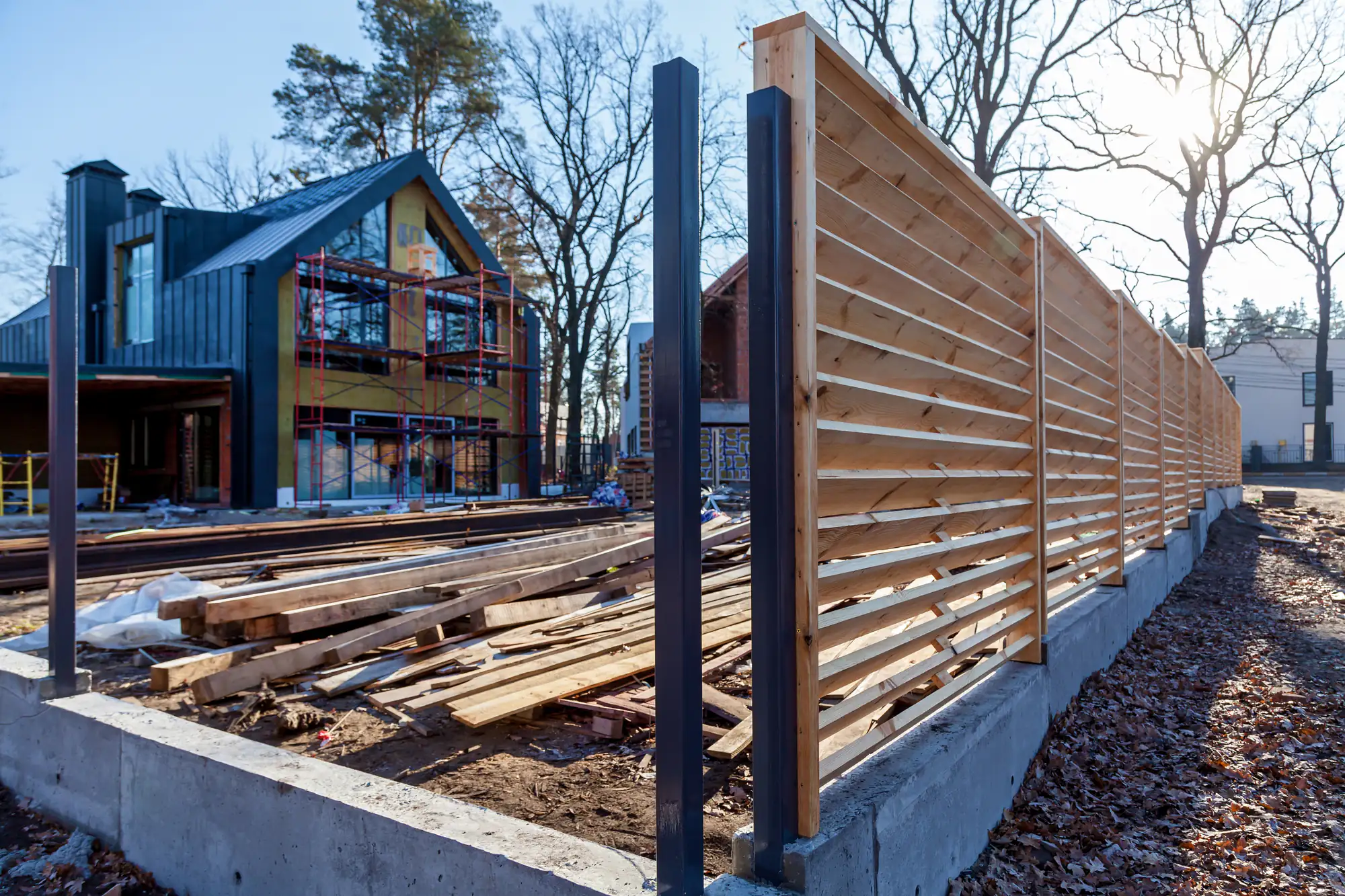
From there, the process moves to post-setting. Posts go into the ground at a minimum depth of one-third their total length, set in concrete. This is the industry standard, and it’s especially important in sandy soil conditions like those found across much of Centereach, Selden, and the surrounding area. Posts that aren’t set deep enough, or that aren’t reinforced properly, are the most common reason fences fail prematurely — particularly after high-wind events.
Once the posts are set and cured, the fence panels go up. Depending on the material — vinyl, wood, aluminum, chain link — the installation timeline varies slightly, but most residential jobs are complete within one to three days. A professional crew cleans up the site when they’re done. If old fencing was removed as part of the job, that goes with them.
Every installation we do comes with a written workmanship warranty. Not a verbal assurance — a written document you keep. Qualifying products also carry manufacturer material warranties. If something isn’t right after the job is done, you have something in writing that protects you.
Serving Every Corner of Suffolk County — Including Spanish-Speaking Homeowners
Suffolk County is one of the most diverse suburban counties in the country. About 22.8 percent of the population identifies as Hispanic or Latino — that’s more than 350,000 people across the county, with particularly large communities in Brentwood, Central Islip, and Selden. These are homeowners with the same questions, the same concerns, and the same need for a contractor they can trust. The difference is that most of them are navigating the entire process — the quote, the contract, the permit paperwork — in a second language.
We offer full bilingual service in English and Spanish. That means every conversation, every question, every line of the contract can be handled in the language you’re most comfortable with. When you’re making a decision that involves your property, your money, and a legal contract, being able to understand exactly what you’re agreeing to matters.
We also offer senior, military, and police discounts because some people have earned a better deal. All of our fence materials are made in America. We accept credit cards and Zelle, and we’re available around the clock for questions and estimates. We serve all of Suffolk County from our home base in Centereach — Selden, Lake Grove, Ronkonkoma, Port Jefferson, Smithtown, Patchogue, Riverhead, and everywhere in between. One local team, one service area, no subcontracting to crews we don’t know.
If you’ve been waiting for a fence company that speaks your language — literally or figuratively — we’re it.
Ready to Find the Right Fence Company Near You in Suffolk County?
The honest version of finding a good fence contractor near you comes down to a few things: verify the license, get it in writing, understand what the quote actually includes, and make sure whoever you hire knows how the permit process works in your specific town. Those four things will protect you from the vast majority of problems homeowners run into.
Suffolk County isn’t a generic market. The soil conditions, the permit complexity, the town-by-town variation, the wind exposure — these are real factors that affect how a fence gets installed and how long it lasts. A contractor who’s been doing this work here for over fifteen years understands that in a way that a national franchise or an out-of-area crew simply doesn’t.
If you’re ready to get a real estimate — written, itemized, no hidden fees — reach out to Best Fence Long Island. We’ll come out, look at the job, and give you a number you can actually count on.
Summary:
Table of Contents


Article details:
- Published by:
- Published to:
- Last modified:
- October 19, 2026
Share: