
Gate Opener Repair in Suffolk County: DIY Fixes vs. Professional Help
Not every gate opener problem needs a service call — but some definitely do. Here’s how to tell the difference before it costs you more than it should.

It usually happens at the worst possible moment. You’re heading out early to catch the Ronkonkoma train, or pulling into your driveway after a long day, and the gate just sits there. No movement, no response, nothing. Before you call anyone or start pulling panels off the wall, it helps to know what you’re actually dealing with. Some gate opener problems are genuinely simple — a dead battery, a tripped breaker, a sensor that got bumped out of alignment. Others look simple but aren’t, and a wrong move can turn a $150 fix into a $500 one. Here’s how to read the situation and know when to handle it yourself versus when to call us.
Common Gate Opener Problems Across Suffolk County
Most gate opener failures fall into a handful of categories: power issues, sensor problems, remote or keypad failures, mechanical wear, and control board faults. The tricky part is that the symptoms often overlap. A gate that reverses unexpectedly could be a misaligned photo-eye sensor, an obstruction in the track, or a failing limit switch — and the fix is different for each one.
Suffolk County adds its own layer of complexity. The freeze-thaw cycles we get every winter cause ground heave that can shift gate posts and throw tracks out of alignment. Salt air from the South Shore — especially in communities along the water in Babylon, Islip, and Patchogue — accelerates corrosion on wiring connections, motor housings, and hardware. After a nor’easter, debris in the track or a power surge is often the culprit.
A gate that “just started acting up” in March may have been quietly struggling since December. That’s why understanding what’s actually happening matters before you spend money on a fix.
Gate Opener Fixes You Can Safely Try Yourself
There’s a real category of gate opener problems that homeowners can handle without any tools, technical knowledge, or risk of making things worse. Knowing what’s in that category saves you time and money.
The first thing to check is always power. A tripped circuit breaker or a blown fuse at the gate’s power supply is one of the most common causes of a completely unresponsive opener — and it takes about thirty seconds to rule out. If the opener has power but the remote isn’t working, replace the battery before assuming anything else is wrong. Dead remote batteries account for a surprisingly large share of “my gate won’t open” calls.
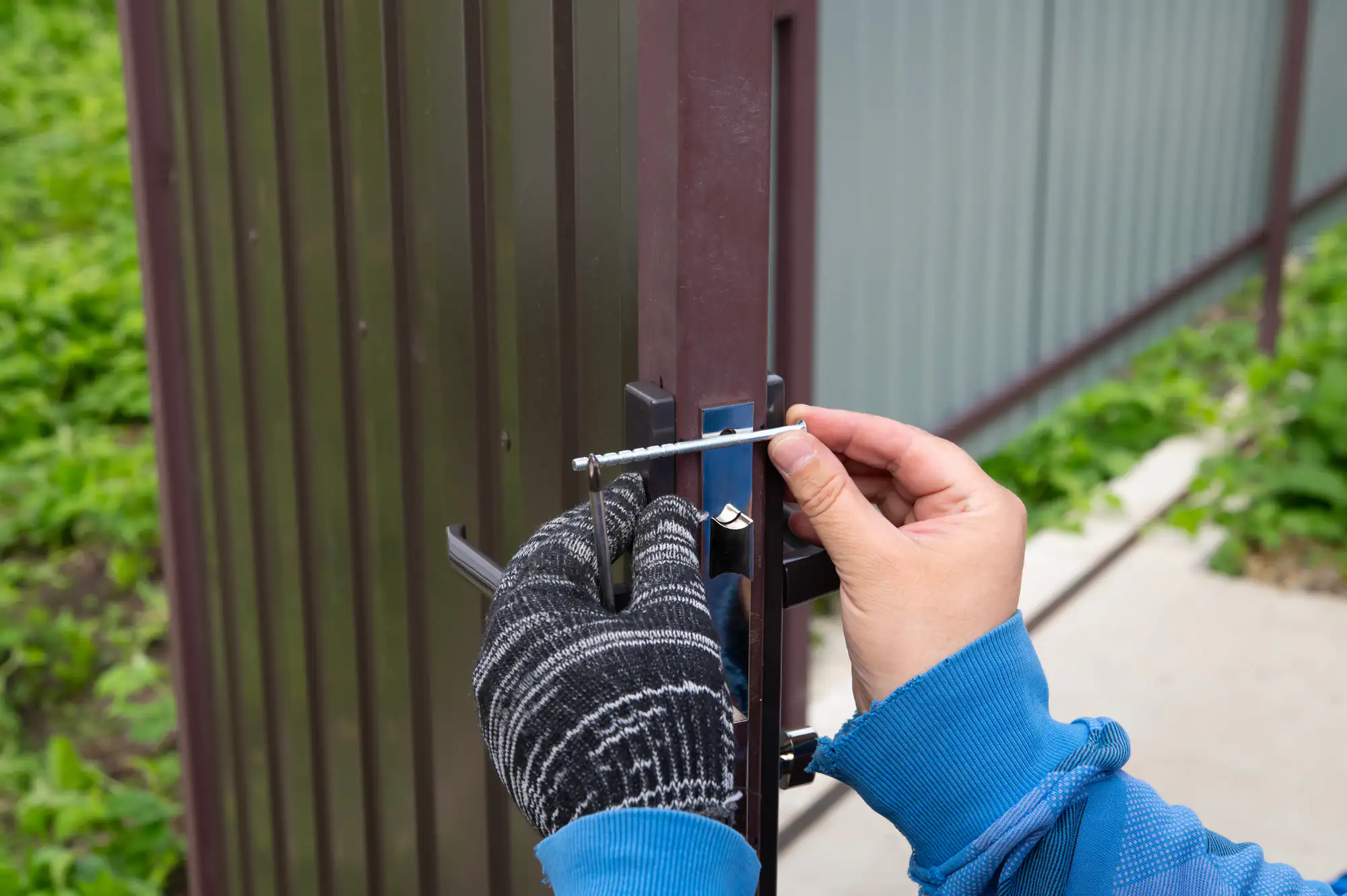
Photo-eye sensors are another area where you can often fix the problem without calling anyone. These are the small sensors mounted near the base of the gate that detect obstructions. They’re sensitive to alignment — if one gets bumped, even slightly, the gate may refuse to close or reverse immediately after starting to move. Most of the time, you can see when they’re out of alignment because the indicator light on the sensor will be blinking or off entirely. Gently realigning them until both lights are solid usually solves it. Cleaning the lenses with a dry cloth helps too, especially after a dusty summer or a wet fall.
If your opener has a manual release cord — most do — you can use it to check whether the problem is mechanical or electrical. Disconnect the opener and try moving the gate by hand. If it moves freely, the mechanical side is probably fine and the issue is in the opener itself. If it’s stiff, binding, or won’t move at all, there’s something structural going on that needs a closer look before you run the motor again.
What you’re doing in all of these cases is narrowing down the cause without touching anything that could make it worse. That’s the goal of DIY troubleshooting — not fixing everything, but figuring out what you’re dealing with.
When Gate Opener Repair Needs a Professional
There’s a clear line between what’s safe to handle yourself and what isn’t, and it mostly comes down to electrical components, motor internals, and anything structural.
If you’ve checked the power, replaced the battery, and confirmed the sensors are aligned — and the gate still isn’t working — the problem is likely in the control board, the motor, or the wiring. These aren’t areas where guessing pays off. A misdiagnosed repair on a control board can damage components that were otherwise fine, and circuit board replacement alone runs $135 to $400 depending on the unit. Motor replacement can run $200 to $450 for parts and labor. If the opener itself needs to be replaced, you’re typically looking at $300 to $700.
Most gate opener manufacturers — including brands like LiftMaster and Mighty Mule — void the warranty if the unit has been tampered with by someone who isn’t a qualified technician. That means a DIY repair attempt on a unit that’s still under warranty can cost you the warranty coverage entirely, turning what might have been a covered repair into a full out-of-pocket replacement.
Structural issues are another category where professional assessment matters. If the gate posts have shifted — which happens regularly across Suffolk County due to winter ground heave — running the motor against a misaligned gate puts stress on the opener arm and the motor itself. The opener isn’t the problem; the gate structure is. We catch that because we assess both the mechanical and structural side of the system.
A gate that’s running slowly, hesitating, making grinding noises, or reversing unexpectedly is in the early stages of a failure, not a minor inconvenience. Ignoring those symptoms usually leads to a complete failure and a more expensive repair. Catching it early with a professional diagnosis is almost always the cheaper path.
Want live answers?
Connect with a Best Fence Long Island expert for fast, friendly support.
How to Choose a Gate Opener Repair Company in Suffolk County
Gate opener repair is a category where homeowners are at a real information disadvantage. The person doing the work knows exactly what’s wrong; you don’t. That dynamic makes it easy to get overcharged, misled about what’s needed, or handed a repair that doesn’t hold.
A few straightforward criteria separate reputable gate contractors from the ones you want to avoid. License and insurance status is the starting point — any contractor doing home improvement work in Suffolk County needs to be licensed through the local town building department. That’s not optional, and it protects you if something goes wrong. Beyond that, what you’re looking for is transparency: a written estimate before any work starts, a clear explanation of what the problem is and what fixing it involves, and a labor warranty that covers the repair after the technician leaves.
What to Ask Before You Hire Anyone for Gate Repair
Most homeowners don’t know what questions to ask when calling around for gate opener repair, which is exactly how they end up with a verbal quote that changes at the end of the job or a repair that fails three weeks later.
The first question is whether the company is licensed and insured for home improvement work in your town. A legitimate contractor will answer this without hesitation and can provide their license number. If there’s any vagueness, that’s a signal to keep looking.
The second question is about the estimate. Ask whether it’s written, whether it’s itemized, and whether the quoted price is the final price. Reputable gate contractors provide written estimates with a breakdown of parts and labor — not a single number that can shift later. The final price should match the quoted price, period.
Third, ask about the labor warranty on the repair itself. Parts often come with a manufacturer warranty, but that doesn’t cover the work done by the technician. A written labor warranty means the company stands behind the repair — if it fails within the warranty period, they come back and fix it. That’s a different thing from a verbal assurance that they’ll “take care of it.”
Finally, ask whether they can assess the full system — not just the opener, but the gate structure, the track, the sensors, and the power supply. A gate opener that keeps failing often has a root cause elsewhere in the system. A gate installation company with experience in the full scope of gate systems will catch that; a technician who only looks at the opener might not.
Any contractor worth hiring will expect these questions.
Suffolk County Permit Requirements for Gate Opener Work
This is one of the things most homeowners don’t find out until they’re already in the middle of a project. Suffolk County encompasses ten separate towns — Babylon, Brookhaven, East Hampton, Huntington, Islip, Riverhead, Shelter Island, Smithtown, Southampton, and Southold — and each one has its own building department with its own requirements.
For a straightforward gate opener repair that doesn’t involve any structural changes or new electrical work, a permit typically isn’t required. But if you’re upgrading to a new opener system, adding an access control panel, running a new power supply to the gate, or making changes to the gate structure itself, most Suffolk County towns will require a permit — and in some cases, a separate electrical permit.
This matters for a few reasons. First, unpermitted work can create problems when you sell the property. Second, if a contractor performs electrical work without the required permits and something goes wrong, your homeowner’s insurance may not cover the damage. Third, some towns require inspections after gate automation work is completed, and skipping that step can create liability.
The permit process in Suffolk County isn’t complicated if you know how it works, but it’s genuinely confusing if you don’t. Which town department handles it, what forms are required, what inspections are needed — it varies by location. We handle the permit paperwork for Suffolk County towns as part of the job, so homeowners don’t have to figure that out on their own.
One more thing worth noting for Suffolk County homeowners specifically: if you have an in-ground pool, the gate on your pool enclosure isn’t just a convenience feature — it’s a legal requirement under New York State’s pool barrier law. That gate needs to be self-closing and self-latching, which means the opener and latch mechanism have to be functioning correctly at all times. A failing pool gate opener isn’t something to put off.
When You’re Ready to Get Your Gate Opener Fixed Right
Gate opener problems have a way of compounding. What starts as a slow response or an occasional reversal turns into a gate that won’t move at all — usually at the moment you least need it. If you’ve worked through the basic checks and the problem is still there, the cost of a professional diagnosis is almost always less than the cost of a wrong DIY attempt.
What matters most when you’re choosing who to call is simple: licensed and insured, written estimate, written labor warranty, and someone who actually knows Suffolk County — the climate, the towns, the permit requirements, and the specific ways Long Island winters and coastal conditions affect gate systems over time.
We’ve been working on gates and fences across Suffolk County for over 15 years. We’re available when you need us — not just during business hours — and we handle the full scope of gate opener repair and installation. If you’re at that point, we’re ready to help.
Summary:
Table of Contents



Article details:
- Published by:
- Published to:
- Last modified:
- October 19, 2026
Share: