Privacy Fence Installation Cost: What Long Island Homeowners Actually Pay
Before you call a single contractor, here’s what privacy fence installation actually costs on Long Island — broken down by material, yard size, and what drives the price up or down.

You’ve probably seen national averages thrown around online — $3,000 here, $10,000 there — and none of it quite adds up to what your neighbor paid or what a contractor quoted you last spring. That’s because fence pricing isn’t one-size-fits-all, and it’s especially not one-size-fits-Long Island.
Suffolk County has its own labor rates, its own permit requirements, and its own climate conditions that affect what materials hold up and what they cost to install properly. If you’re trying to figure out what a privacy fence will actually run you before committing to anything, this is the breakdown you need.
Privacy Fence Options in Suffolk County: Understanding Your Choices
Most homeowners start thinking they’re choosing between wood and vinyl. That’s true, but the decision goes deeper than that — because the material you choose is the single biggest variable in what you’ll pay, both upfront and over the life of the fence.
In Suffolk County, the most common residential privacy fence materials are vinyl (PVC), wood (typically pressure-treated pine or cedar), aluminum, and composite. Each has a different cost profile, a different maintenance demand, and a different performance record in Long Island’s specific climate. Understanding those differences before you talk to a contractor puts you in a much better position to make the right choice for your property.
How Much Does a Privacy Fence Cost Per Linear Foot on Long Island?
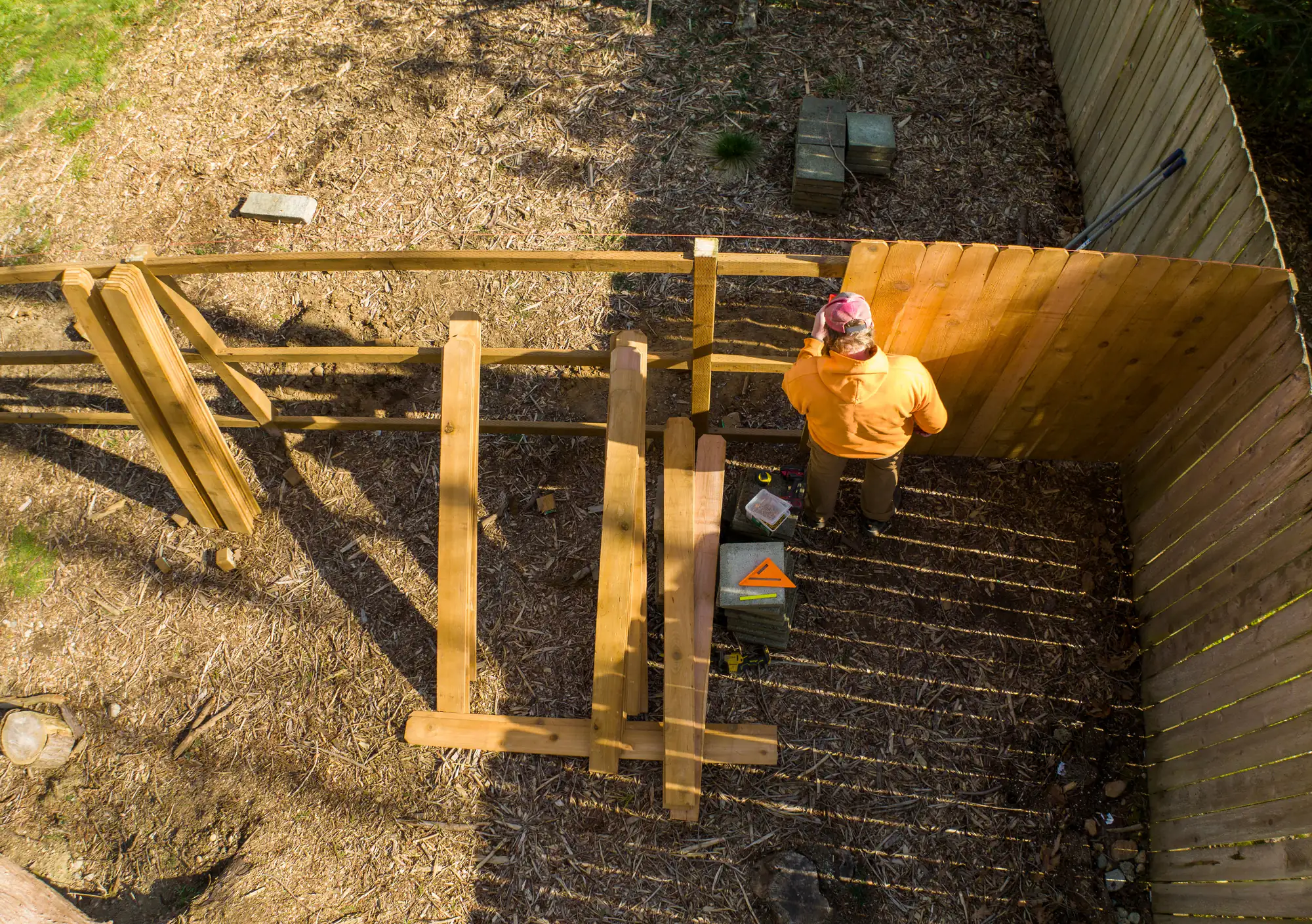
Here’s what you’re looking at in Suffolk County right now. Vinyl privacy fence installation runs between $34 and $53 per linear foot for a 6-foot fence — meaningfully higher than the national average of $20 to $40 per linear foot. That gap reflects New York labor rates, local material costs, and the reality that quality installation in this market costs more.
Wood privacy fence in Suffolk County runs between $20 and $34 per linear foot installed. For a typical backyard project in the 100–200 linear foot range — which covers most quarter-acre to half-acre lots in communities like Selden, Ronkonkoma, or Smithtown — you’re looking at roughly $2,500 to $6,700 for wood, or $3,400 to over $10,000 for vinyl, depending on fence height, gate placement, and site conditions.
Those are wide ranges, and they’re meant to be. The difference between a $4,000 job and a $7,000 job on the same size yard often comes down to material grade, the number of gates, whether old fencing needs to be removed, and whether the site has slopes, tree roots, or rocky soil that complicate post-setting. A contractor who gives you a firm number without seeing the property first is guessing — and that guess tends to show up as a surprise charge later.
The national average cost for a fencing job in 2024 was $6,300. Long Island projects tend to land at or above that figure for a standard privacy fence. That’s not a markup — it’s the market. A quote in the $3,000 range for a full backyard on Long Island warrants a closer look at what’s actually included.
What Drives the Price Up — and What You Can Control
Fence pricing isn’t arbitrary. There are real cost drivers behind every quote, and knowing them helps you make smarter decisions about where it’s worth spending more and where you can save without sacrificing quality.
Fence height is straightforward. A 4-foot fence uses less material than a 6-foot fence, so it costs less per linear foot and less overall. Most Suffolk County homeowners installing a privacy fence go with 6 feet — it’s the standard height for rear yard privacy, and it’s what most municipalities allow without a variance. Front yard fences typically max out at 4 feet under local codes.
Permits, site prep, and terrain can add 10 to 25 percent to your total cost, and this surprises more homeowners than almost anything else. Suffolk County’s 10 towns — Brookhaven, Smithtown, Babylon, Islip, Huntington, and the rest — each run their own code enforcement offices and have their own fence permit requirements. What’s required in Port Jefferson may differ from what’s required in Patchogue. If your contractor doesn’t know this or doesn’t handle the paperwork, you may end up doing it yourself or risking an installation that doesn’t pass inspection.
Gates add hardware, hinges, a latch, and additional labor — and most yards need at least one, often two. If your quote doesn’t itemize gate costs separately, ask for that breakdown.
Old fence removal is the last one worth flagging. If you’re replacing an existing fence, the old posts and panels have to come out, and that’s labor the contractor has to account for. An itemized quote tells you immediately whether it’s included.
Want live answers?
Connect with a Best Fence Long Island expert for fast, friendly support.
Privacy Fence Materials: Which One Makes Sense for Long Island
Every material has a pitch, and every contractor has a preference. What matters is how each one performs in the specific conditions Suffolk County throws at it — salt air near the south shore and Long Island Sound, freeze-thaw cycles that push shallow fence posts right out of the ground, and the kind of wind loads that come with nor’easters.
The material conversation isn’t just about aesthetics or upfront price. It’s about what you’ll be dealing with five, ten, and twenty years from now.

Vinyl vs. Wood Privacy Fence: The Real Long-Term Cost Comparison
Wood is cheaper upfront. A pressure-treated pine privacy fence will cost less per linear foot than vinyl, and for homeowners working with a tighter budget, that matters. But wood requires ongoing maintenance — staining or sealing every few years, rot repair on boards that take on moisture, and eventual replacement of posts that deteriorate at the base. A quality wood privacy fence typically lasts 10 to 15 years with proper upkeep. Without it, you’re looking at replacement sooner.
Vinyl costs more upfront, but it doesn’t rot, warp, rust, or need painting. It handles Long Island’s humidity, coastal salt air, and winter freeze-thaw cycles without the maintenance burden that wood requires. Quality vinyl fences — specifically those made from virgin PVC with co-extruded profiles and UV inhibitors — are engineered to hold up in northeastern climates for 20 to 30 years or more.
The misconception that vinyl cracks in cold weather usually traces back to low-grade imported vinyl, not the professional-grade material used by reputable contractors. There’s a quality spectrum within vinyl that most homeowners don’t realize exists. Big-box vinyl and professional-grade vinyl are not the same product. The difference shows up in wall thickness, UV resistance, post construction (aluminum-reinforced posts vs. hollow), and how the panels interlock.
If you’re on the south shore — Patchogue, Babylon, or anywhere near the Great South Bay — or on the north shore near the Sound, vinyl is worth serious consideration specifically because salt air accelerates the deterioration of wood and metal. For those locations, the upfront premium often pays for itself before the first wood fence would need replacing.
Do I Need a Permit for a Privacy Fence in Suffolk County?
This is one of the most common questions homeowners ask, and the honest answer is: it depends on where in Suffolk County you live and how tall your fence is. There is no single countywide rule. Each of the 10 towns administers its own building and zoning codes, which means the permit requirements in Riverhead are not necessarily the same as in Huntington or Islip.
As a general baseline, most Suffolk County municipalities require a permit for fences over a certain height — typically 4 feet in front yards and 6 feet in rear yards, though some towns require permits for any fence regardless of height. Installing without a required permit can result in fines or, in some cases, a forced removal order.
We handle permit paperwork for Suffolk County towns as part of our installation process. That means you don’t have to figure out which town office to call, which forms to file, or what documentation the inspector will want to see. It’s one of those details that sounds minor until you’re standing at a town counter trying to explain your fence plans.
There’s one more permit situation worth knowing about: New York State law requires a fence of at least 4 feet around any residential swimming pool more than 24 inches deep. Suffolk County has a high density of in-ground and above-ground pools, and pool fence installations have their own code requirements that go beyond standard residential fencing. If you’re installing a fence around a pool, make sure your contractor knows the specific requirements.
Getting an Honest Privacy Fence Quote in Suffolk County
The most important thing you can take away from this is simple: the quote matters as much as the price. A low number that doesn’t include permits, gates, or site prep isn’t a deal — it’s a setup for a conversation you don’t want to have mid-project. An itemized quote that tells you exactly what’s included, with a final price that doesn’t change, is worth more than the cheapest number you can find.
We’ve been installing fences across Suffolk County for over 15 years, from Centereach out to Riverhead and down to Patchogue. We offer free on-site estimates with written, itemized quotes — no vague totals, no hidden fees. The price we quote is the price you pay. We also carry a written workmanship warranty on every installation, handle permit paperwork for Suffolk County towns, and install only American-made materials backed by manufacturer warranties on qualifying products.
If you’re in the research stage and not ready to call anyone yet, that’s completely fine — that’s exactly what this guide is for. When you are ready to get a real number for your property, Best Fence Long Island is here to give you one.
Summary:
Table of Contents


Article details:
- Published by:
- Published to:
- Last modified:
- October 19, 2026
Share: