Privacy Fence Styles: From Full Privacy to Open Picket
Not sure which privacy fence style fits your yard? This guide walks you through every option — from solid panels to semi-open designs — so you can choose with confidence.

Most homeowners searching for a privacy fence already know what they want to feel — they want to sit in their backyard without feeling like they’re on display. What they’re less sure about is which style actually gets them there, and whether it’ll look good, hold up in a nor’easter, and pass muster with their town’s building department.
That’s a fair amount to figure out before you’ve even called anyone. We’ve laid out the full spectrum of privacy fence styles — what each one looks like, how it performs in Suffolk County conditions, and what makes it the right or wrong fit for your yard specifically.
Privacy Fence Options: Understanding the Full Spectrum
Privacy fencing isn’t one thing. It’s a range — from solid panels that block every sightline completely, to semi-open designs that filter views without closing off your yard entirely. Where you land on that spectrum depends on your lot, your neighbors, your HOA rules, and honestly, how much you actually want to see out as well as in.
The most common full-privacy styles are stockade, board-on-board, and tongue-and-groove. Semi-privacy options include shadowbox and louvered designs. And then there’s the open end of the spectrum — picket fences — which define your property line without blocking much of anything. Each style has a different look, a different wind profile, and a different relationship with the people on the other side of it.
Full-Privacy Fence Styles: Stockade, Board-on-Board, and Tongue-and-Groove
Stockade is the style most people picture when they hear “privacy fence” — vertical boards placed tightly side by side, all facing the same direction, with pointed or flat tops. It’s the most affordable full-privacy option and the most common replacement fence across Long Island. The tradeoff is that it has a clear “good side” and a “bad side.” The finished face points outward toward your neighbor or the street; the structural rails are on your side. In most Suffolk County towns, that’s not just a convention — it’s a code requirement.
Board-on-board — sometimes called overlapping board — solves that problem. Pickets are staggered on alternating sides of the rail, so both faces look finished. It’s the most popular style in neighborhoods where lots are close together, because your neighbor sees the same thing you do. It also allows a small amount of air to pass through, which matters more than most people think when a nor’easter rolls through in February.
Tongue-and-groove fencing locks each board into the next with a fitted joint, creating a truly solid panel with no gaps at all. It’s the quietest option — the interlocking construction actually dampens sound — which makes it a strong choice for homes near busier roads in communities like Ronkonkoma or along the commercial corridors in Smithtown. The tradeoff is cost and the fact that a fully solid panel catches the full force of wind, so post depth and concrete footings become even more important.
In Suffolk County’s sandy glacial soil, that’s not a detail to skip. Sandy soil drains well but has low load-bearing capacity, which means posts set too shallow will lean or blow over after the first significant storm. We know to go deeper here than contractors in markets with denser, clay-heavy ground — it’s one of the details that separates a fence that lasts from one that doesn’t.
Semi-Privacy Fence Styles: When You Want Privacy Without a Wall
Shadowbox fencing is the most popular semi-privacy style, and for good reason. Boards alternate on either side of a center rail, creating a pattern that looks solid from straight on but allows air and partial light through at an angle. Like board-on-board, it looks identical from both sides — which makes it a genuine “good neighbor” design. If your fence line is also your neighbor’s fence line, that matters.
The wind performance of shadowbox is also meaningfully better than a solid panel. Because air can pass through the gaps, the fence doesn’t act as a full sail in a storm. For Suffolk County homeowners who’ve watched a solid stockade fence lean and buckle after a nor’easter, this is worth factoring into the style decision — not just the aesthetics.
Louvered fencing takes the airflow concept further, with angled slats that allow ventilation while still blocking direct sightlines. It’s less common in residential applications here, but it works well in situations where a yard needs airflow — around a pool, for example, or in a spot where a solid fence might create a wind tunnel effect against a structure.
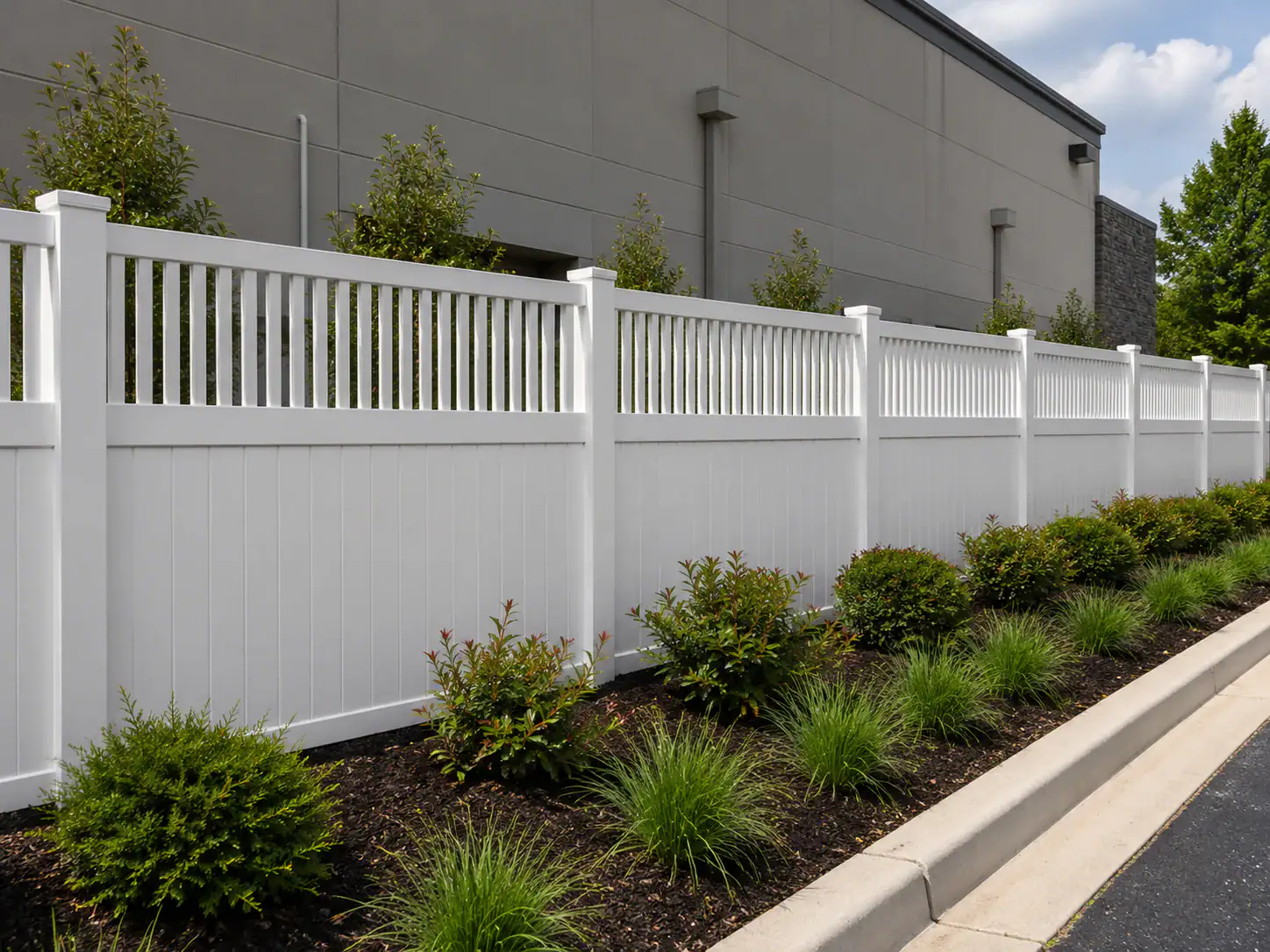
Lattice-top fencing sits in an interesting middle ground. The lower portion is typically a solid panel (stockade or board-on-board), and the upper section is an open lattice. It gives you full privacy at eye level while keeping the top of the fence visually lighter. It’s a good option for homeowners who want privacy but don’t want a fence that feels imposing from the street. In communities with HOA aesthetic guidelines, lattice-top designs are often easier to get approved than a straight solid panel.
One thing worth understanding about semi-privacy styles: the privacy level depends heavily on the angle of view. Shadowbox fencing gives you near-complete privacy from someone standing directly across from you, but less so from someone at an angle — say, a neighbor on a raised deck. If elevated sightlines are your concern, that’s a conversation worth having before you commit to a style.
Want live answers?
Connect with a Best Fence Long Island expert for fast, friendly support.
Picket Fence vs. Privacy Fence: Knowing Which One You Actually Need
These two fence types serve genuinely different purposes, and it’s worth being clear about that before you start getting quotes. A privacy fence — typically six feet tall — is designed to block sightlines, contain people and pets, and create a defined private space. A picket fence — usually three to four feet — is designed to mark a boundary, add curb appeal, and contain smaller pets, without blocking views or light.
Neither is better. They’re different tools. The right question is what you’re actually trying to accomplish in each part of your yard.

Where Picket Fences Make Sense — and Where They Don’t
Picket fences are almost always a front-yard choice. They look welcoming, they frame the property without closing it off, and they work with the aesthetic of most Suffolk County residential neighborhoods — particularly the older post-war housing stock in communities like Lake Grove, Selden, and Port Jefferson. In many towns, a picket fence is also the only option that’s practical in the front yard, since front-yard fences in most residential zones are capped at three to four feet.
Where picket fences fall short is obvious: they don’t give you privacy. If you’re trying to screen your backyard from neighbors, contain a large dog, or create a secure space for kids, a picket fence isn’t going to do it. A decorative three-foot fence is a boundary marker, not a barrier.
That said, some homeowners use both — a full-privacy fence along the sides and rear of the property, and a shorter picket or decorative fence across the front. It’s a combination that gives you the privacy and security you want in the back while keeping the street-facing appearance open and inviting. In neighborhoods with HOA guidelines, this kind of split approach often satisfies both the aesthetic requirements for the front and the privacy needs for the back.
Vinyl picket fences have become increasingly popular in Suffolk County because they hold up to the coastal climate without the maintenance that painted wood requires. Salt air and humidity do a number on wood over time — the same conditions that shorten the lifespan of a wood privacy fence apply to a wood picket fence as well. A vinyl picket fence can be rinsed clean and will hold its color without repainting for decades.
Privacy Fence Height in Suffolk County: What the Rules Actually Say
Height is one of the first questions homeowners ask, and it’s one of the most important to get right before you build anything. In Suffolk County, fence height regulations vary by town — each of the county’s ten towns has its own building department and its own code — but the general pattern is consistent: backyard fences are typically permitted up to six feet without a special variance, while front yard fences are capped at three to four feet in most residential zones.
The Town of Islip, for example, limits solid residential fences to six feet above grade. Other Suffolk County towns follow a similar framework. If you’re hoping to go to eight feet for additional screening — say, because a neighbor has a raised deck or a second-story window with a direct sightline into your yard — that typically requires a variance, and the process and likelihood of approval vary by town.
This is one reason permit handling matters as much as it does in this market. Most homeowners don’t know which permits their specific town requires, which department to contact, or what the setback rules are for their zone. Getting that wrong can mean fines, stop-work orders, or being required to remove a fence you just paid to install. We handle the permit paperwork for Suffolk County towns as part of the installation process — so you don’t have to navigate that on your own.
Six feet is also worth thinking about in terms of what it actually delivers. A six-foot solid fence will give you complete privacy from anyone standing at grade on the other side. If your neighbor’s yard is elevated, or if they have a deck or patio above grade, six feet may not be enough. In those cases, the style choice matters as much as the height — a lattice-top design, for instance, adds visual height without requiring a permit for a taller solid structure.
One more thing worth knowing: the “good side” rule. In most Suffolk County towns, the finished face of a fence — the side without exposed rails and hardware — is required to face outward, toward the neighbor or the street. It’s also just the right thing to do. Board-on-board and shadowbox styles sidestep this entirely because both faces look finished. If you’re installing a stockade fence, the orientation matters and your contractor should know the local convention without being asked.
Choosing the Right Privacy Fence Style for Your Suffolk County Yard
The style decision is the one that shapes everything else — your material options, your cost, your permit requirements, and how your fence holds up through the next ten years of Long Island weather. Get it right and you won’t be thinking about your fence again for a long time. Get it wrong and you’ll be replacing it sooner than you planned.
If you’re still weighing your options, here’s what we recommend: board-on-board and shadowbox are the most versatile choices for dense suburban neighborhoods where both sides of the fence are visible. Stockade is the most cost-effective full-privacy option when the orientation works. Tongue-and-groove is the right call if sound dampening matters. And if you’re fencing the full perimeter — which most privacy fence projects eventually become — we offer a free gate with every installation over 100 linear feet.
When you’re ready to talk through what makes sense for your specific yard, Best Fence Long Island is based right here in Centereach and serves all of Suffolk County. We provide free on-site estimates, itemized written quotes, and no surprises when the invoice arrives.
Summary:
Table of Contents

Article details:
- Published by:
- Published to:
- Last modified:
- October 19, 2026
Share: