Fence Installation in Fort Salonga, NY
Gold Coast Property. Your Fence Should Match It.
Hear from Our Customers
Fence Contractors Serving Fort Salonga
A fence that’s installed correctly on a Fort Salonga property does a few things at once. It defines your boundary clearly, holds up through nor’easters and hard winters, and doesn’t become a neighbor dispute because someone eyeballed the property line on a two-acre lot. That last part matters more here than in most towns on Long Island.
Fort Salonga’s clay-rich soil the same deposits that once powered the hamlet’s brickworks industry retains moisture in a way that sandy or loamy soil doesn’t. When that moisture freezes and expands around a fence post, it pushes upward. Posts that aren’t set deep enough with the right concrete volume will lean or fail after one or two bad winters. That’s not a material problem. That’s an installation problem, and it’s avoidable when the contractor specifies post depth and concrete volume in writing before a single hole is dug.
Then there’s the salt exposure. Long Island Sound sits directly north of Fort Salonga, and the spray travels further inland than most homeowners expect. The right material choice cedar for wood, vinyl for zero-corrosion maintenance makes a real difference in how long your fence lasts without costly repairs. These aren’t abstract considerations. They’re what separates a fence that looks the same in year ten as it did in year one from one that’s already showing wear by year three.
Fence Company near Fort Salonga, NY
We’ve been installing fences across Suffolk County for over 15 years including the North Shore communities where coastal conditions, large wooded lots, and complex permit requirements make every job a little more involved than a standard suburban installation. Fort Salonga is one of those places, and we know it well.
We’ve worked on properties near Crab Meadow Beach, along the winding roads off Route 25A, and on lots where the boundary runs along a stone wall that’s been there longer than the house. We know that some Fort Salonga addresses fall under the Town of Smithtown’s building department and others fall under the Town of Huntington and that those two jurisdictions have different permit thresholds, different fee structures, and different fence height rules. We sort that out before you ever have to ask.
Every job starts with a professional site visit. We verify property lines, locate utilities, and give you an itemized quote that spells out exactly what you’re getting lineal footage, post spacing, post depth, and concrete volumes. No ballpark numbers. No surprises at invoice time.
Fence Installation Process in Fort Salonga
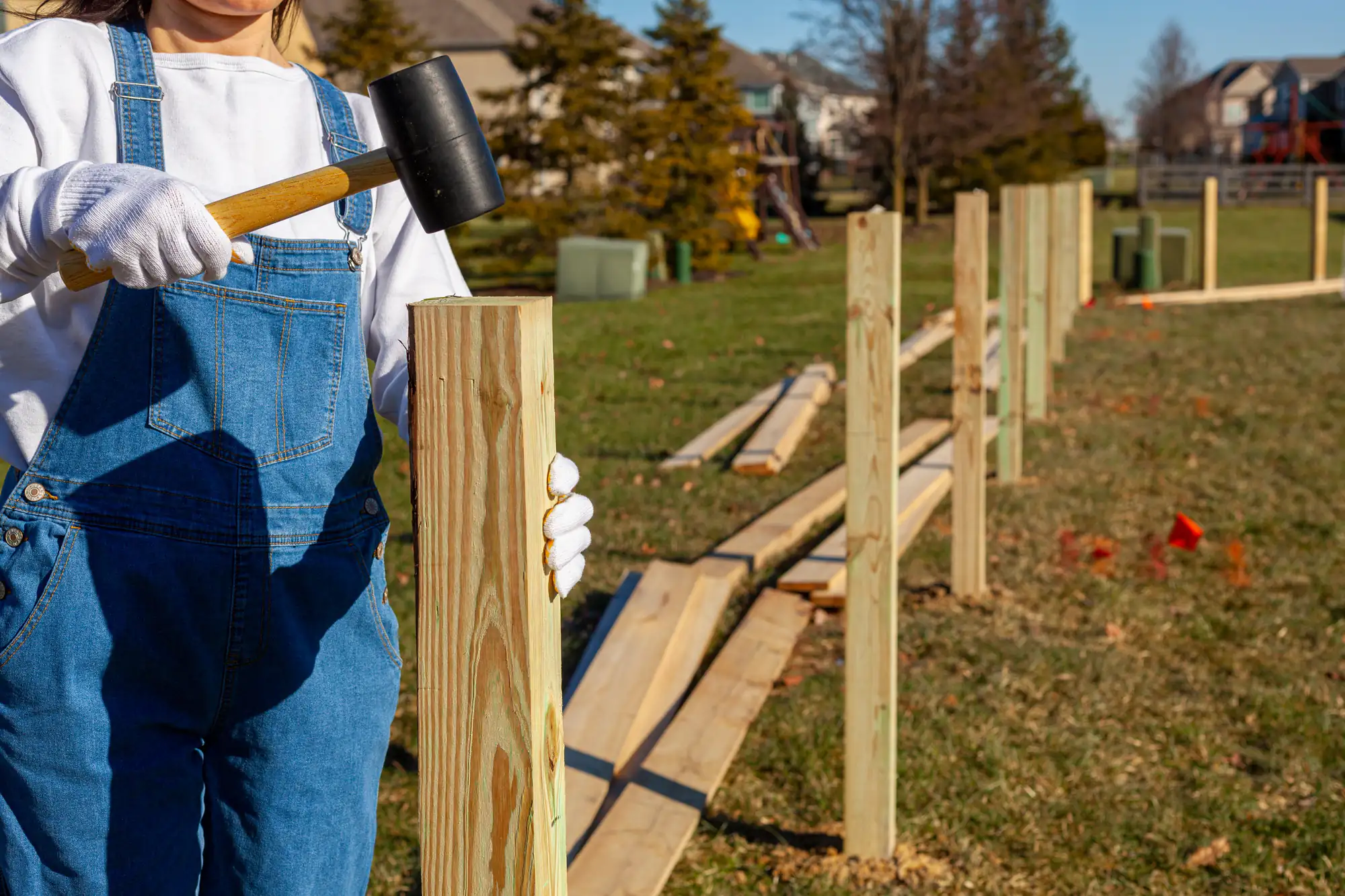
It starts with a site visit, not a phone estimate. Fort Salonga’s large lots, mature tree lines, and historic property boundaries make an in-person look non-negotiable. We come out, walk the property with you, confirm the boundary, and identify anything underground that needs to be cleared before digging starts. New York State law requires calling 811 before any excavation we handle that as standard, not as an afterthought.
From there, you get a written, itemized quote. Not a single number. A breakdown that tells you exactly how many linear feet of fence, how deep each post goes, how much concrete anchors it, and what material is being used. If your property falls under the Town of Smithtown, a permit is required for any fence over four feet. If you’re on the Huntington side, the threshold is six feet for standard residential zones, with additional review for waterfront-adjacent properties near the Sound. We know which applies to your address, and we guide you through the permit process so it doesn’t become a delay.
Once permits are in place, installation is scheduled. Our crews work with American-made materials throughout no imported panels optimized for cost over quality. When the job is done, both your workmanship and your materials are covered under warranty. One company, one call, one warranty if anything ever needs attention.
Ready to get started?
Fence Builders near Fort Salonga, NY
Fort Salonga properties aren’t small, and they’re not simple. One to two acres of wooded, irregular terrain often with stone walls marking boundaries that are decades old means fence installation here requires more preparation, more precision, and more local knowledge than a standard quarter-acre lot in a more suburban part of Suffolk County.
The materials we use are all manufactured in the United States. For North Shore properties with Sound exposure, that means cedar or vinyl for wood and low-maintenance applications, and aluminum or ornamental steel for perimeter and estate-style fencing that needs to hold up against salt air without corroding hardware and hinges over time. If you’re near Crab Meadow or along Waterside Road, material selection isn’t just aesthetic it’s structural longevity.
We also install smart technology-integrated fence systems, which are a natural fit for Fort Salonga’s larger, more security-conscious properties. Gates can be connected to your home security system and controlled via mobile app. Modular fence systems are available if you anticipate changes to your property over time adding a pool, expanding a garden, reconfiguring an outdoor space so you’re not starting from scratch every time the property evolves. And if a nor’easter or fallen tree takes out a section, storm and vehicle damage repair is covered. We also support homeowners through the insurance documentation process, which matters when you’re filing a claim and need a contractor who knows what an adjuster needs to see.
Do I need a fence permit in Fort Salonga, and which town handles it?
This is one of the most common questions we get from Fort Salonga homeowners, and it’s a genuinely complicated one because the answer depends on which side of the hamlet your property sits on. Fort Salonga straddles two separate municipalities: the Town of Smithtown to the east and the Town of Huntington to the west, with the dividing line running roughly along Bread and Cheese Hollow Road.
In the Town of Smithtown, a fence up to four feet in height can be installed without a permit. Anything taller requires a building permit submitted to Smithtown’s Building Department. In the Town of Huntington, the threshold is six feet in standard residential zones but properties near the waterfront or within areas subject to additional review may face extra requirements. A survey is typically required as part of Huntington’s permit application process. If you’re not sure which town governs your address, that’s exactly the kind of thing we confirm during our initial site visit before any work begins.
How much does fence installation typically cost in Fort Salonga, NY?
Fence installation on Long Island generally runs between $12 and $40 per linear foot depending on the material vinyl, wood, aluminum, and chain link all fall at different points in that range. Fort Salonga projects tend to land toward the higher end of total project cost not because the per-foot price is inflated, but because the properties here are larger. A fence run on a one-to-two-acre lot is simply longer than what you’d find on a standard suburban parcel in Holbrook or Centereach, so the total scope is bigger.
Material choice also matters in a coastal environment. Vinyl and cedar hold up better against salt air than untreated wood, and aluminum outperforms standard steel hardware near the Sound. Those material decisions affect cost but also affect how long the fence lasts without needing repair or replacement which is the number that actually matters when you’re protecting a property with a median value approaching $917,000. Every quote we provide is itemized with lineal footage, post depth, post spacing, and concrete volumes so you can evaluate exactly what you’re paying for.
What fence materials hold up best near Long Island Sound in Fort Salonga?
Salt spray off Long Island Sound travels further inland than most homeowners expect, and Fort Salonga’s North Shore position means properties along Waterside Road, near Crab Meadow Beach, and throughout the Sound-facing sections of the hamlet deal with accelerated corrosion on metal components and faster degradation of untreated wood. The material choices that hold up best here are vinyl, cedar, and aluminum each for different reasons.
Vinyl is completely impervious to salt corrosion and requires almost no maintenance, which makes it a popular choice for waterfront-adjacent properties. Cedar has natural oils that resist rot and insects, making it the preferred wood option for North Shore installations where you still want the look of wood without constant treatment. Aluminum is the right call for ornamental or estate-style perimeter fencing it won’t rust the way standard steel hardware does when exposed to coastal air year after year. We also factor in Fort Salonga’s clay soil when setting posts, because clay retains moisture and amplifies frost heave pressure in winter, which means post depth and concrete volume aren’t details we leave to chance.
How do you verify my property line before installing a fence on a large Fort Salonga lot?
Property line verification is a standard part of our site visit process not an optional add-on. On a large, irregularly shaped lot in Fort Salonga, where boundaries are often marked by stone walls, old hedgerows, or survey stakes that may be decades out of date, getting this wrong has real consequences. A fence installed six inches over the line on a two-acre property is not a minor inconvenience it’s a legal dispute with your neighbor and a costly reinstallation.
During the site visit, we review your available survey documentation and walk the boundary with you. If there’s any ambiguity which is common on the older, winding lots along roads like Old Dock Road or in sections near the Geissler Estate area we flag it before a single post hole is dug. If a current survey is needed, we’ll tell you upfront so you can get one ordered before the project starts. This step protects you legally and ensures the fence ends up exactly where it belongs.
A nor’easter knocked down part of my fence can I file an insurance claim for this?
Yes, in most cases sudden storm damage to a fence is covered under a standard homeowners insurance policy as long as the damage was caused by a covered peril which typically includes wind, fallen trees, and coastal storm events. Fort Salonga’s exposure to Long Island Sound makes this a very real scenario for homeowners near the water, and nor’easters that roll through from the northeast can take out significant sections of fencing in a single storm.
The key is documentation. Your insurance adjuster will need clear photos of the damage, a written estimate from a licensed contractor, and in some cases a description of what caused the damage. We support homeowners through this process we document the damage properly, provide the written estimate in the format adjusters need, and can coordinate the repair timeline around your claim. If a fallen tree or high winds have compromised your fence and you have children or pets on the property, we also prioritize getting the situation secured quickly while the claim is being processed.
How long does fence installation take from first contact to finished job in Fort Salonga?
The honest answer is that it depends on a few factors specific to Fort Salonga primarily permit timing and project scope. For smaller projects that fall under the permit thresholds in either Smithtown or Huntington, the timeline from site visit to installation can move relatively quickly. For larger projects or those requiring a building permit, you need to factor in the permit review and approval period, which varies by town and current workload at the building department.
On the installation side, Fort Salonga’s larger lot sizes mean fence runs are typically longer than average, and the presence of mature trees, root systems, and clay soil can add time to the post-setting process. We factor all of this into the project schedule from the start so you’re not caught off guard mid-job. Spring is the busiest season for fence installation across Suffolk County, so if you’re planning a spring project, earlier outreach in late winter gives you more scheduling flexibility. For storm damage situations, we prioritize response time and can often get to a property assessment faster than a standard new-installation request.
Useful Links
Other Services we provide in Fort Salonga